

The Digital Hive Framework™
Nobody sits down on day one and thinks:
I'd like my website to say one thing, my social media another + my enquiries something completely different.
Nobody plans to build a disconnected business.

Bit of SEO over here.
A brand refresh over there.
Three offers nobody has quite found the words for yet.
Perfect.
Obviously, that is not the plan.
It happens much more innocently.
The business grows. The audience changes. Something stops working, so you fix it. Something new gets added.
Every decision makes sense.
And that is precisely how the problem starts.
Because businesses don't usually become disconnected through terrible decisions.
They become disconnected through perfectly reasonable decisions that were never asked to work together.
And for quite a while?
Nobody notices.
Until the website is introducing the business you were eighteen months ago.
Your content sounds more confident than your homepage.
The offers have evolved, but their language hasn't.
Nothing looks dramatically broken.
The pieces have simply stopped talking to one another.
And while you remember why every decision was made, your customers don't.
They only experience what those decisions add up to.
The thing that looks wrong isn't always the thing that's wrong.
A quiet inbox looks like a visibility problem. A tired website looks like a design problem. Content that has stopped working looks like a creativity problem.
And sometimes, that is exactly what it is.
But sometimes the website doesn't need prettier design. It needs clearer positioning. More traffic won't help if people arrive at an offer they don't quite understand. Better hooks won't fix content that has nothing distinctive to say.
Which is why fixing the thing you can see doesn't always change very much.
The symptom appears in one place.
The cause may live somewhere else entirely.
And that changes the question.
Instead of immediately asking What should we make?, we start with:
What is actually happening here?
Because your customers experience one business.
Your marketing can accidentally describe seven.
And sometimes the biggest opportunity isn't another improvement to one of the pieces.
It's what happens between them.

The pattern I couldn’t stop seeing.
For years, I thought this was simply an annoying habit of my brain.
Someone would ask me about their website and I’d end up thinking about their positioning. We’d talk about SEO and I’d wonder whether the people arriving from Google would actually understand what they found.
A content problem would send me backwards into the offers.
Apparently, I was supposed to stay in the marketing box we’d started in.
My brain had other plans.
Eventually, I realised something.
I wasn’t making the work more complicated.
I was noticing complexity that was already there.
The industry had divided marketing into neat disciplines.
Customers had received no such memo.
They don’t experience your positioning separately from your website, your brand separately from your copy, or your content separately from what happens when they enquire.
They experience the cumulative effect.
And once I saw that, I couldn’t really unsee it.
That thinking became The Digital Hive Framework™.
The Digital Hive Framework™
Six connected lenses for seeing the business differently.
The Digital Hive Framework™ is The Digital Hive Studio's methodology for understanding how a business's strategy, positioning, messaging, brand, website, content, visibility + customer experience shape one another.
Created by Natty Bernasconi, Founder + Strategic Director of The Digital Hive Studio, it grew from years of working across different marketing disciplines + repeatedly encountering the same pattern:
The problem somebody arrives with isn't always the problem that needs solving.
So instead of beginning with a predetermined answer, we look through six connected lenses:
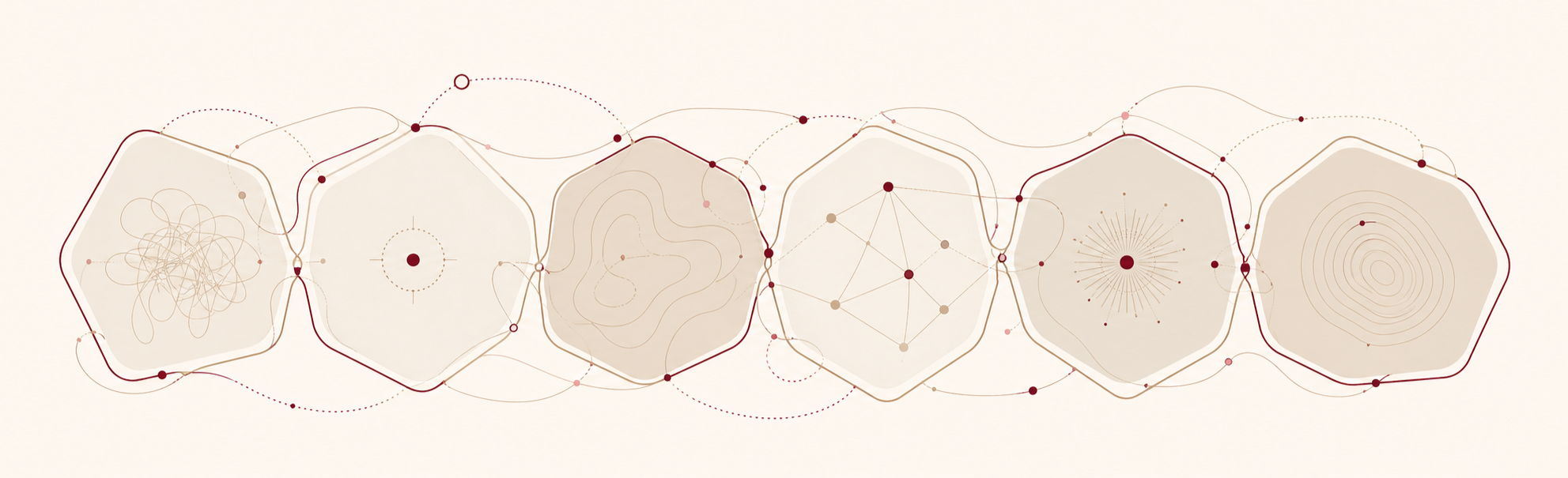
UNTANGLE → DEFINE → SHAPE → CONNECT → ACTIVATE → EVOLVE
Untangle finds the drift.
Define finds the centre of gravity.
Shape makes the thinking visible.
Connect protects the handovers.
Activate gives the ideas somewhere useful to go.
Evolve keeps the meaning intact while the business moves.
They aren't six boxes every business has to tick.
And they aren't a neat little sequence your business is expected to obediently follow.
Different businesses enter at different points, revisit different lenses + need different answers.
Because a useful Framework shouldn't give every business the same answer.
It should help us find the better question.

01 — UNTANGLE
See what being this close has taught you not to notice.
You know why every decision was made.
Your customer doesn't.
Untangle gives us enough distance to see the business without all the history attached to it. What still fits? What belongs to an earlier version? What has become so familiar that nobody thinks to question it anymore?
Businesses rarely wake up broken.
They drift first.

02 — DEFINE
Decide what people should be able to say when you’re not in the room.
Growing businesses collect things.
More expertise. More offers. More audiences. More ways to explain what they do.
Eventually, you can have plenty to say + no obvious centre of gravity.
Define finds the idea the rest of the business can organise itself around.
Because people won't remember the paragraph.
They'll remember the point.

03 — SHAPE
Make the thinking impossible to miss.
Your strategy could be brilliant.
Your customer is never going to read the strategy document.
They'll meet it through your messaging, identity, copy, website, offers + all the tiny details that make a business feel considered.
Shape turns the thinking into something people can actually experience.
People don't experience your strategy. They experience the evidence that it exists.

04 — CONNECT
Pay attention to the handovers, not only the headlines.
Instagram → website.
Google → homepage.
Lead magnet → inbox.
Marketing → enquiry.
Every one is a handover. And every handover either continues the thought or makes your customer start again.
Connect makes sure the pieces recognise one another.
Your social media shouldn't feel as though it has never met your website.
Consistency isn't repetition. It's recognition without re-explanation.

05 — ACTIVATE
Stop asking the content calendar to invent the strategy.
When the thinking underneath the marketing is clear, Monday morning doesn't have to begin with:
What on earth should we post?
Content can deepen an idea. Email can continue it. Search can help someone discover it.
Activate turns clarity into useful movement.
Instead of asking what should we make?, ask:
What needs repeating, answering, proving or moving forward?

06 — EVOLVE
Your business changed. Apparently nobody told the website.
Offers change. Expertise deepens. Audiences mature.
Meanwhile, the About page is still introducing the business you were two years ago, your Instagram is talking about the business you are now, and somewhere in an email sequence you're selling something you quietly stopped caring about in February.
That's how the thread gets lost.
Evolve is about catching the drift before your marketing becomes a collection of different eras of the same business.
Not starting again. Just making sure everything has caught up.
From The Studio
Sometimes the brief is only the first clue.
Johanna Åsterdal came to The Digital Hive for help with her marketing.
A perfectly reasonable brief.
Except marketing wasn't where we needed to start.
Because before we could work out how to market the business, we needed to get clearer on what people were supposed to remember about it.
And that changed everything downstream.
The core message shaped the website copy + build. The website sharpened the visual direction, offers + content. And the marketing finally had something much stronger to build on.
What started as help me with my marketing became a much wider body of work — and an ongoing partnership as the business evolved.
In Johanna's words, it gave her “clarity on how to prioritise and be strategic moving forward.”
The brief wasn't wrong.
It just wasn't the whole story.
Pull one thread. See what else moves.
That's The Digital Hive Framework™ in practice.

Client: YogiBean
Brand + digital ecosystem
This isn't another thing we sell.
The Digital Hive Framework™ isn't another service sitting on the menu.
It's the thinking underneath the menu.
Someone might hire us for strategy, brand, a website, copy, SEO + AI search, content, email — or ongoing strategic + creative support.
But the deliverable isn't where our thinking begins.
First, we need to understand what already exists, what the business is trying to become + what is happening between the pieces.
Which is also why you don't need to diagnose yourself before getting in touch. Frankly, if you already knew exactly where the problem began, there's a reasonable chance you wouldn't need us.

The thinking doesn't stop here.

The Hive Index™
See what’s happening before you start fixing it.
Not every marketing problem needs another strategy, rebrand or website.
The Hive Index™ helps you look across the business, spot where things may have stopped connecting + work out what actually deserves your attention.

Neurodivergent Marketing™
Your marketing shouldn't require a different brain to run it.
A different way of thinking about marketing for brains that don't necessarily thrive on rigid routines, relentless consistency + systems designed for somebody else.
Because a strategy only works if you can actually work with it.

Human-first Marketing
There is still a person on both sides of the strategy.
AI can make marketing faster. Automation can make it easier. Data can make it smarter.
None of them make the person at the other end less human.
This is where we think about what should change as technology does — and what probably shouldn't.

Created by Natty Bernasconi.
Founder + Strategic Director, The Digital Hive Studio
The Digital Hive Framework™ didn't begin as an attempt to invent a methodology.
It began with clients coming to Natty for one thing — and the work repeatedly needing to start somewhere else.
A marketing brief would uncover a messaging problem.
A website project would raise questions about the offer.
Content would lead back to positioning.
Different brief. Different business. Same recurring question:
What else is this affecting?
Eventually, the question became a methodology.

You probably don't need to rebuild everything.
That's worth saying.
When a business feels disconnected, the temptation is often to start again.
New brand. New website. New strategy. New everything.
Sometimes, that's exactly what's needed.
Quite often, it isn't.
There may already be an enormous amount worth keeping.
The job isn't to throw away good decisions because they stopped talking to each other.
It's to work out which decisions still belong to the business you're becoming — then reconnect the rest around them.
Most businesses keep improving the pieces.
The businesses people remember protect what happens between them.
A few things you might reasonably be wondering.
-
The Digital Hive Framework™ is The Digital Hive Studio's methodology for understanding how strategy, positioning, messaging, brand, websites, content, SEO, visibility + customer experience affect one another.
Its six connected lenses help reveal what's strong, where the business has drifted + what actually deserves attention next.
-
Untangle. Define. Shape. Connect. Activate. Evolve.
Together, they help us step back from what exists, find the central idea, make that thinking tangible, strengthen the connections, put the strategy to work + protect the business's meaning as it grows.
-
No.
Real businesses have an irritating habit of refusing to evolve in six beautifully organised stages.
The lenses are connected rather than strictly sequential. Different businesses enter at different points + revisit them as their offers, audiences, priorities + circumstances change.
-
A marketing plan usually tells you what you're going to do, where + when.
The Digital Hive Framework™ looks underneath those activities first.
Is the positioning clear?
Does the messaging support it?
Does the brand make it believable?
Does the website continue the thought?
Can the content build on it?
Does the customer journey make sense?
Because there isn't much value in deciding to publish four times a week if nobody is quite sure what the business needs to become known for.
Or increasing website traffic before fixing what people find when they arrive.
Or creating another campaign around an offer that is still difficult to understand.
The Framework works underneath the activity.
Once those relationships make sense, the marketing plan has a much better foundation.
-
Marketing often feels disconnected because positioning, messaging, brand, website and content were created at different moments for different versions of the business. Each activity may work on paper while the overall impression becomes harder to understand or trust.
-
A website falls out of step when the business changes but the site keeps introducing the person you used to be. The mismatch is not always a design failure. It may mean the business evolved and forgot to take the website with it.
-
Messaging decides what people need to understand. Branding helps them recognise and believe it. SEO makes that expertise easier to find. The real test comes after the click: does the website continue the promise made by the search result, or quietly change the subject?
-
Because the obvious answer is often answering the wrong question. Low website conversions, for example, may point to positioning, messaging, trust, unsuitable traffic or friction long before they point to the button.